Chinese cuisine
has a long history, and is one of the Chinese cultural
treasures. It is as famous all over the world as French cuisine.
Chinese cookery has developed and matured over the centuries,
forming a rich cultural content. It is characterized by fine
selection of ingredients, precise processing, particular care to
the amount of fire, and substantial nourishment. Local flavours
and snacks and special dishes have formed according to regions,
local products, climate, historical factors, and eating habits.
There are four major local cuisine in China. Each local cuisine
has its own characteristics, but Chinese cuisine as a whole is
divided into four major schools-Shandong, Sichuan, huaiyang, and
Guangdong (Cantonese). Four more can be added: Hunan, Fuijian,
Anhui, and Zhejiang. Sometimes Beijing and Shanghai cuisine are
also counted.
In addition, China has Special Cuisine including Palace,
vegetarian, and medicinal dishes are categorized a special
cuisine.
China also has some local flavors and snacks In recent years,
fast food, such as Mcdonald's hamburgers, Kuntucky Fried
Chicken, and pizza have become popular in China.
Four Major
China Local Cuisine
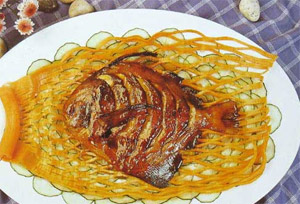
Guangdong cuisine (Yue Cai): Guangdong cuisine uses a great variety of ingredients
such as birds, freshwater fish, snakes, and saltwater fish. It
emphasizes freshness and tenderness. Representative dishes of
the Guangdong cuisine are three snake dragon tiger meeting,
dragon tiger phoenix snake soup, stir-fried shrimp,
eight-treasure lotus-seed glutinous rice, fresh mushrooms in
oyster sauce, pot-cooked soft-shelled turtle, and crisp-skin
roast piglet.
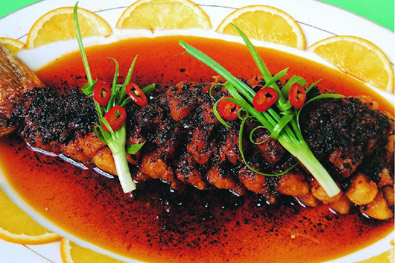
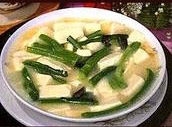
Yue Cuisine: Fried Fish
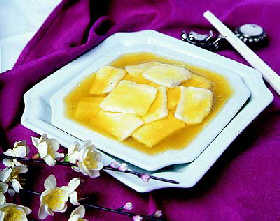
Shandong cuisine (Lu Cai):
This cuisine uses a wide and fine selection of ingredients. The
plentiful dishes are cooked in many ways. Shandong soups are
most famous, and green onion is commonly used as a seasoning.
Shandong cuisine is best represented by its variety of seafood
dishes, such as sea cucumber braised with green onion, braised
snake-head egg, crab eggs with shark's fin, Dezhou roast
chicken, and walnuts in butter soup.
Lu Cuisine: Sliced Fish
Sichuan cuisine (Chuan Cai):
Sichuan cuisine dishes are famous in China and abroad for their
spicy-hot taste and the flavour of Chinese prickly ash. Sichuan
cooks select their ingredients with great care, use a variety of
seasonings and cook each dishes are differently. Thus Sichuan
dishes are known as a hundred dishes with a hundred tastes. Most
common flavour include hot and spicy, five fragrances, mixed
spices, chilli and Chinese prickly ash, and sweet and sour.
Famous Sichuan dishes include spicy pork shreds, diced chicken
with peanuts and vegetables, bear's paw, chicken cubes in mixed
spices, bean curd with chilli and Chinese prickly ash and fried
carp.
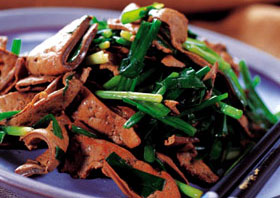
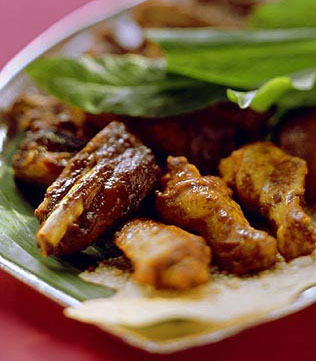
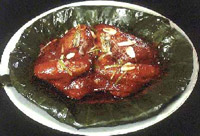
Chuan Cuisine:
Vegetable Cooked with Sheep Liver
Huaiyang cuisine (Huaiyang Cai):
Huaiyang cuisine includes dishes from Yangzhou, Zhenjiang, and
Huai'an in Jiangsu Province. It focuses on the freshness of
ingredients. Huaiyang dishes have a light flavour, retaining the
original tastes of ingredients. They also have pleasant colors
and pretty shapes. Famous dishes include beggar's chicken, sweet
and sour mandarin fish, chicken pieces with egg white, boiled
salted duck deep-boiled crab meat in clear soup and steamed
shad.
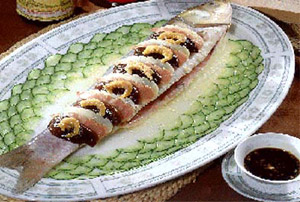
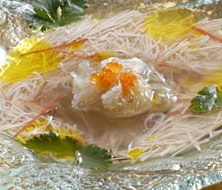
Huaiyang Cuisine:
Steamed Fish
China Special Cuisine:
Palace,
vegetarian, and medicinal dishes are categorized a special
cuisine.
Palace cuisine
originated from the imperial kitchens, where dishes for
emperors and empresses were cooked. Palace dishes are made
from carefully selected ingredients and cooked with great
care. Different dishes are made for different seasons.
Cutting methods are exquisite. Diners eat according to
traditional procedures.
Vegetarian cuisine:
Vegetarian cuisine became popular in the Song Dynasty
(960-1279) and developed further in the Ming and
Qing(1368-1911) dynasties. Three divisions of vegetarian
cuisine—temple, palace, and folk- appeared during that time.
Made of green vegetables, fruits, edible fungi, and bean
products, and cooked in vegetable oil, vegetarian dishes are
tasty, nourishing, and highly digestible, and they help the
body resist cancer. They are cooked in various ways, and
some taste like meat. Famous dishes include "chicken",
mushrooms and gluten, "meat" braised in soy sauce and
spices, "ham" with mixed vegetables, hot and sour spices,
"fish" with Chinese toon, "shrimp," and dried "meat" strips.
Muslim dishes became
popular at the time when Islam spread to China, inheriting
the cooking tradition of the nomadic peoples in ancient
north-western and north-eastern China. The most
representative dishes include instant-boiled mutton, fried
rice with mutton, dumplings with filling of mutton, cakes
braised with mutton, and beef-entrails soup.
Medicinal cuisine: Also
called therapeutic food, medicinal cuisine is an important
part of Chinese cooking. Master Chefs have developed many
food therapies by combining cookery and traditional Chinese
medicine. Famous medicinal dishes include lily and chicken
soup, shrimp meat with pearl powder, tianfu carp, duck
braised with soy sauce and orange peel, and steamed
dumplings stuffed with minced meat and podia cocoas, a
medicinal plant.
Other famous cuisine includes Confucian dishes,
Tan's dishes and full formal banquet cuisine,
combining Manchurian and Chinese delicacies (Manhan Quanxi).
China Local Flavors and Snacks:
China has
many local flavors and snacks. The southerners prefer rice,
while the northerners prefer noodles. Beijing flavor is
famous for sweetness, Guangdong snacks are more Western, and
Suzhou snacks have pleasant colors and beautiful shapes. The
most famous Chinese local flavors and snacks include bean
curd jelly in Beijing; Goubuli steamed dumplings in Tianjin,
small steamed soup dumplings with the ovaries and digestive
organs of crabs in Zhenjiang, small steamed pork dumplings
served in the steamer tray in Shanghai, dumplings stuffed
with crab meat sesame paste and pea sprouts.
This web site is created by
InfoPacific Development Inc. and jointly managed by
InfoPacific Development Inc. (Canada) and
Kompass (China) Information Service Co. Ltd.
This site
is frequently updated and permanently "under construction".
All rights reserved.
Advertisement
on this website? Please CLICK
HERE. Customers in
China, please call our China Office at:
Beijing Office: (8610) 6424 8799 and (8610) 6424 8801
All the
information provided in this
website is for informational purposes only. Chinatoday.com disclaims all
liability or responsibility for the accuracy and completeness of the
information provided in this website and the opinions by publications
related to this website do not necessarily reflect the views of
Chinatoday.com or any of its affiliates.



 Chinese Culture