 |
|
All Topics and Classifieds |
|

 |



|
General Information of the People's Republic of China (PRC) |
|
|
|
China boasts a total land area of 9.6
million square kilometers, across four time zones. Beijing, the capital
of China, is located in the Eastern 8th Zone, "Beijing Time" is the standard for the
whole country. (For China general information, Click the following links to get a quick review) | Administrative Divisions | Map of Administrative Division | Armed Force | Capital | Civil Electrical Power | Climate | Constitution | Economic Growth Rate | Date of Establishment | Dynasties | Family Names | GDP | History | Interesting Statistics | Internet Domain Code | Languages | Location in the World | Measures & Weights | Main Ports of Entry | Currency (Money) | National Flag, Emblem & Anthem | Nationalities | China Calendar, Official Holidays and Working Hours | Population | President | Religions | Rivers | Road Drive Side | Ruling Party | State Organs | Telephone Area Code | Topography | TV System | Weather | |
-
CAPITAL: Beijing Area: 16,800 square kilometers; Population: 21.84 million (by 2022) (click for more information about Beijing)
-
CHINA CLIMATE INFORMATION: China lies mainly in the northern temperate zone under the influence of monsoon. From September and October to March and April next year monsoon blow from Siberia and the Mongolia Plateau into China and decrease in force as it goes southward, causing dry and cold winter in the country and a temperature difference of 40 degree centigrade between the north and south. The temperature in China in the winter is 5 to 18 degree centigrade lower than that in other countries on the same latitude in winter. Monsoon blows into China from the ocean in summer, bringing with them warm and wet currents, thus rain. Great differences in climate are found from region to region owing to China's extensive territory and complex topography. The northern part of Heilongjiang Province in northeast China has no summer, Hainan Island has a long summer but no winter; the Huaihe River valley features four distinct seasons; the western part of the Qinghai-Tibet Plateau is covered by snow all year round; the southern part of the Yunan-Guizhou Plateau is spring-like all the year; and the northwestern inland region sees a great drop of temperature in the day. Annual precipitation also varies greatly from region to region; it is as high as 1,500 millimeters along the southeastern coast. Decreasing landward, it is less than 50 millimeters in northwest China. (Click for Current China Weather Information)
- DATE
OF ESTABLISHMENT OF THE PEOPLE'S REPUPLIC OF CHINA:
October 1, 1949
- CHINA
POPULATION: Total Population 1.37 billion
(2013 data)
(click
for information of the most recent census and related figures).
711.82 million in urben area (2013 data) , share 52.6% of total
population in China.
China population is distributed unevenly with more in the east (more than 300 persons per square kilometer) and fewer in the west (about 40 persons per square kilometer. The national average density of population is 143 per square kilometer (2013 census). For basic urban population data, please visit "ChinaToday.com". Provinces and Cities page. The average size of household was 3.7 persons.
The proportion of population aged at 0-14 was 26.4 percent, those aged 15-64 was 67.2 percent, and that of the people aged 65 and over was 6.4 percent. The Average Chinese Life-Span of the population was 70.8 years, that for male was 68.71, and female, 73.04. (Some of the above data are based on the report from China National Statistics Bureau, FOR YOUR REFERENCE ONLY).
-
GDP US$14.08 Trillion (2020)
(Archive Figures: 24661.9 billion yuan RMB (3425.3 billion US$) a 11.4% increase over 2006. Compare GDP (in 1999, China's GDP was 8205.4 billion yuan RMB, about $980.6 billion US$) , (click for China Economic Growth Rate between 1977-2010)
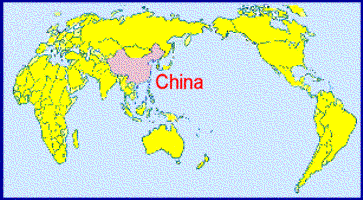
China's location in the world
-
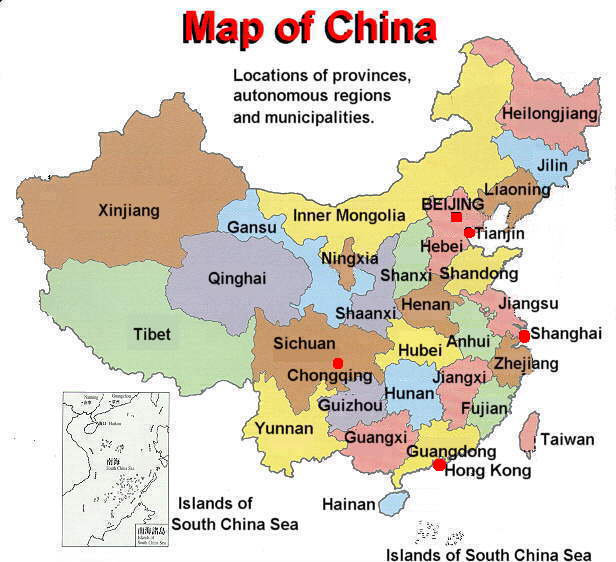
China Map - Administrative Divisions (click for more information about China Map)

-
CHINA ADMINISTRATIVE DIVISIONS (Provinces, Autonomous Regions and Municipalities) (China has 23 provinces, 5 autonomous regions, 4 municipalities and 2 Special Administrative Regions - Hong Kong and Macao). For the locations of these administrative divisions. (click for more details about China's provinces and cities)
-
HISTORY: China, one of the four oldest civilizations in the world, has a written history of 4,000 years and boasts rich cultural relics and historical sites. It is the inventor of compass, paper-making, gunpowder and printing. The Great Wall, Grand Canal and Karez irrigation system are three great ancient engineering projects built 2,000 years ago. Now they are the symbols of the rich culture of the Chinese nation. China has gone over a long history of primitive society, slavery society, feudal society and semi-feudal semi-colonial society and the present socialist society. (click for more information about China's history)
-
CHINA'S STATE ORGANS: (click for general information of Chinese government)
New Year's Day: January 1
Chinese Lunar New Year's Day: (Between January and February。 The exact date varies, depends on the Lunar Calendar), Chinese New Year's Day in 2017 is Jan 28. For further information: click for Chinese Zodiac page.);
Labor Day: May 1;
National Day: October 1
The working days are from Monday to Friday. Most people do not work on weekend. Official hours are from 8:00am to 17:00pm with one hour for lunch.
- LANGUAGES: The national language is Putonghua (the common speech) or Mandarin, which is one of the five working languages at the United Nations. Most of the 55 minority nationalities have their own languages. Cantonese is one of the local dialects of southern China. As a written language, Chinese has been used for 6,000 years.
-
NATIONALITIES: The People's Republic of China is a unified, multi-national country, comprising 56 nationalities. The Han people make up 91.02 percent of the total population, leaving 8.98 percent for the other 55 ethnic minorities. They are Mongolian, Hui, Tibetan, Uygur, Miao, Yi, Zhuang, Bouyei, Korean, Manchu, Dong, Yao, Bai, Tujia, Hani, Kazak, Dai, Li, Lisu, Va, She, Gaoshan, Lahu, Shui, Dongxiang, Naxi, Jingpo, Kirgiz, Tu, Daur, Mulam, Qiang, Blang, Salar, Maonan, Gelo, Xibe, Achang, Pumi, Tajik, Nu, Ozbek, Russian, Ewenki, Benglong, Bonan, Yugur, Jing, Tatar, Drung, Oroqen, Hezhen, Moinba, Lhoba and Gelo. All nationalities in China are equal according to the law. The State protects their lawful rights and interests and promotes equality, unity and mutual help among them. (click for pictures of the above mentioned Chinese nationalities)
-
CHINESE FAMILY NAMES: Chinese family names came into being some 5,000 years ago. There are more than 5,000 family names, of which 200 to 300 are polular. The order of Chinese names is family name goes first, following by given name. For instance, the family name of a person is Wang, given name is Dong, his/her full name would be Wang Dong . The most popular Chinese family names are LI, ZHANG, WANG, LI, ZHAO, LIU, CHEN. According to the most recent official statistics in 2007, the three most popular family names in China are: WANG (total 92.88 million, shares 7.25% of total China population); LI (total 92.07 million, shares 7.19% of total China population) and ZHANG (total 87.50 million, share 6.83% of total China population). (click for more China population information)
-
CHINA'S MAJOR RIVERS: China has 50,000 rivers each covering a catchment area of more than 100 square kilometers, and 1,500 of them cover a catchment area exceeding 1,000 square kilometers. Most of them flow from west to east to empty into the Pacific Ocean. Main rivers include the Yangtze (Changjiang), Yellow (Huanghe), Heilong, Pearl (Zhujiang River), Liaohe, Haihe, Qiangtang and Lancang. The Yangtze of 6,300 kilometers is the longest river in China. The second longest Yellow River is 5,464 kilometers. The Grand Canal from Hangzhou to Beijing is a great water project in ancient China. It is of 1,794 kilometers, making it the longest canal in the world. (Click for information about China's three most important river deltas -- the Yangtze River Delta, Yellow River Delta, and the Zhujiang River Delta )
-
CHINA'S RELIGIONS: China is a multi-religious country. Buddhism, Taoism, Islam, Catholicism and Protestantism, with the first three being more wide spread.Various religions exert different influence on different ethnic groups. Islam is followed by the Hui, Uygur, Kazak, Kirgiz, Tatar, Dongxiang, Salar and Bonan nationalities; Buddhism and Lamaism are followed by the Tibetan, Mongolian, Dai and Yugur nationalities; Christianity is followed by the Miao, Yao and Yi nationalities; Shamanism is followed by the Oroqen, Ewenki and Daur nationalities; the majority Han nationality believes in Buddhism, Christianity and Taoism. (click for more information about China religions)
-
CHINESE MONEY: Chinese Money is called Renminbi (RMB) (means "People's Currency"). The popular unit of RMB is Yuan. The official exchange rate between U.S. Dollar and Renminbi Yuan currently is about 1 : 8.3 (1.00 Dollar = 8.30 Yuan). 1 Yuan to 10 Jiao, 1 Jiao to 10 Fen (There are parts of China the Yuan is also known as Kuai and Jiao is known as Mao. Chinese currency is issued in the following denominations: one, two, five, ten, fifty and a hundred Yuan; one, two and five Jiao; and one, two and five Fen. (click for more details about Renminbi)
-
CHINA CIVIL ELECTRICAL POWER: AC 220 V, 50 Hz (bathrooms of many luxury and medium-grade hotels may have 110-volt sockets).
-
CHINA TELEVISION SYSTEM: PAL (In addition to Chinese language TV broadcast, English and Japanese TV programs are available in many hotel via satellite relay. China Central Television Station (CCTV) and some local TV stations also provide English news and other programs in English.) (click for more detailed information about Chinese media)
(For the telephone code of major Chinese cities, please click HERE).
Continental China: on the right
Hong Kong: on the left
Macau: on the left
Taiwan: on the right
-
INTERNET DOMAIN CODE: .cn (such as "....org.cn" , "...edu.cn" or "....com.cn"), Hong Kong .hk, Macau: .mo
China can be visited through out the year because of the stretch of its territories and sites and activities it can offer. Deciding when to visit China depends on which places you wish to visit, what type of weather you enjoy, and how much a bargain you want. China is a huge country with many different climates and types of landscape. Think of it in terms of the United States, which China resembles in size and shape. Traveling along the Golden Route (Beijing, Xian, Shanghai, Guilin) is like visiting New York, Chicago, Santa Fe, and Jacksonville, Florida all in one trip.
April, May, September and October are the peak tourist months at China’s
most popular destinations when the weather is the most comfortable. Prices
drop a bit in the shoulder season, which runs from November through March
and from June through August. However, the winter months are peak season
for trips to China’s Hainan Island and to the Northeast Harbin for its
world-famous ice-lantern festival.
This months are also packed with New Year holidays, Chinese
Spring Festival and other national or local happy fairs.
Summer months are great time to explore China’s Far
East-Manchuria.
China has a continental and seasonal climate. Most parts are in the temperate zone but southern areas are in the tropical or subtropical zone while northern areas are in the frigid zone. Climates in different areas are complicated. For instance, northern Heilongjiang Province has a winter climate the year round without summer, while Hainan Island has a summer climate the year round without winter. The following is a reference table for tourists to prepare clothing on their trips.
-
Spring: 10-22°C, Western suits, jackets, sports coats, woolen jackets, long sleeve shirts and travel shoes.
-
Summer: 22°C and above, T-shirts, short sleeve shirts, skirts, sandals, caps, rain wear.
-
Autumn: 10-22°C, Western suits, jackets, sports coats, light woolen sweaters, rain wear and travel shoes
Winter: 10°C or lower, overcoat, cotton clothes, lined coats. In very cold areas a cap, gloves and cotton-padded shoes are required.
| CITY | JAN | FEB | MAR | APR | MAY | JUN | JUL | AUG | SEP | OCT | NOV | DEC |
| Beijing |
-4.1 25 |
-1.6 29 |
4.9 41 |
13.6 57 |
20.0 68 |
25.2 77 |
27.9 82 |
26.6 80 |
20.3 69 |
12.7 55 |
4.2 40 |
-2.2 28 |
| Chengde |
-9.2 15 |
-5.5 22 |
2.1 36 |
11.5 53 |
18.4 65 |
22.3 72 |
24.3 76 |
22.8 73 |
17.1 63 |
10.0 50 |
0.4 33 |
-7.2 19 |
| Chengdu |
5.5 42 |
7.4 45 |
11.7 53 |
16.7 62 |
20.9 70 |
23.6 75 |
25.3 78 |
24.9 77 |
21.2 70 |
16.7 62 |
11.4 53 |
7.1 45 |
| Chongqing |
7.5 46 |
9.1 48 |
13.8 57 |
18.4 65 |
21.8 71 |
24.7 77 |
28.3 83 |
28.3 83 |
23.4 74 |
18.4 65 |
13.6. 57 |
9.1 48 |
| Dalian |
-4.5 24 |
-2.9 27 |
2.4 36 |
9.5 49 |
15.6 60 |
19.7 67.0 |
23.0 73 |
24.0 76 |
20.0 68 |
13.7 57 |
5.8 42 |
-1.0 30 |
| Datong |
-11.0 12 |
-7.4 19 |
0 32 |
8.5 47 |
15.7 60 |
19.9 68 |
21.8 71 |
20.0 68 |
14.4 58 |
7.5 45 |
-1.4 29 |
-8.8 16 |
| Guangzhou |
13.2 56 |
14.1 58 |
17.8 64 |
22.0 72 |
25.6 78 |
27.4 81 |
28.7 84 |
28.5 83 |
27.1 81 |
23.8 75 |
19.3 67 |
15.1 59 |
| Guilin |
7.8 46 |
9.0 48 |
12.9 55 |
18.5 65 |
23.0 73 |
26.2 79 |
28.1 83 |
27.8 82 |
25.5 78 |
20.5 69 |
15.2 59 |
10.2 50 |
| Hangzhou |
3.9 39 |
5.2 42 |
9.3 48 |
15.4 59 |
20.3 69 |
24.3 76 |
28.5 83 |
27.9 82 |
23.3 74 |
17.7 64 |
12.2 54 |
6.3 43 |
| HongKong |
15.8 60 |
15.9 61 |
18.5 65 |
22.2 72 |
25.9 79 |
27.8 82 |
28.8 84 |
28.4 83 |
27.6 81 |
25.2 77 |
21.4 70 |
17.6 64 |
| Huangshan |
-2.8 27 |
-1.6 29 |
2.3 36 |
7.7 46 |
11.9 53 |
14.9 59 |
17.6 64 |
17.3 63 |
13.7 57 |
9.2 48 |
4.0 39 |
-0.6 31 |
| Kunming |
7.9 46 |
10.0 50 |
13.2 56 |
16.6 62 |
19.1 67 |
19.6 67 |
19.7 67 |
19.0 66 |
17.2 63 |
14.6 58 |
11.1 52 |
8.0 46 |
| Lhasa |
-2.1 28 |
0.9 34 |
4.5 40 |
8.1 46 |
11.8 53 |
15.7 60 |
15.3 59 |
14.4 58 |
12.7 55 |
8.2 46 |
2.1 36 |
-1.6 29 |
| Luoyang |
0.4 33 |
2.7 37 |
8.4 47 |
15.4 59 |
21.2 70 |
26.3 79 |
27.3 81 |
26.0 79 |
21.1 70 |
15.3 59 |
8.3 47 |
2.3 36 |
| Nanjing |
2.1 36 |
3.9 39 |
8.5 47 |
15.0 59 |
20.1 68 |
24.6 77 |
27.9 82.0 |
27.4 81 |
22.4 72 |
16.6 62 |
10.2 50 |
4.3 40 |
| Qingdao |
0.7 31 |
-0.4 31 |
4.7 40 |
10.5 51 |
15.9 60 |
20.0 68 |
23.8 75 |
25.2 77 |
21.5 70 |
16.1 61 |
8.9 48 |
2.0 35 |
| Sanya |
21.2 70 |
22.2 72 |
24.2 76 |
26.6 79 |
28.3 83 |
28.5 83 |
28.5 83 |
28.0 82 |
27.3 81 |
26.1 79 |
24.2 76 |
21.9 71 |
| Shanghai |
4.7 40 |
8.2 46 |
13.4 56 |
18.5 65 |
22.9 73 |
27.2 81 |
27.5 82 |
24.1 76 |
18.8 66 |
12.8 55.0 |
6.9 44 |
4.0 39 |
| Suzhou |
3.2 38 |
4.3 40 |
8.6 47 |
14.5 58 |
19.6 67 |
23.8 75 |
28.0 82 |
27.7 82 |
23.1 73 |
17.7 64 |
11.9 53 |
5.6 42 |
| Urumqi |
-13.9 7 |
-11.6 11 |
-1.8 29 |
9.8 50 |
16.9 62 |
21.8 71 |
24.2 76 |
22.7 73 |
16.7 62 |
7.6 46 |
-3.1 26 |
-11 12 |
| Wuhan |
3.2 38 |
5.2 42 |
9.8 50 |
16.3 61 |
21.5 71 |
25.6 78 |
28.7 84 |
28.2 83 |
23.2 73 |
17.4 63 |
11.2 52 |
5.4 42 |
| Wuxi |
2.8 37 |
4.0 39 |
8.4 47 |
14.4 58 |
19.6 67 |
23.8 75 |
28.0 82 |
27.6 82 |
22.8 73 |
17.2 63 |
11.3 52 |
5.0 41 |
| Xiamen |
13.0 55 |
13.4 56 |
15.5 60 |
19.7 67 |
23.2 73 |
25.9 79 |
27.6 82 |
27.2 81 |
25.5 78 |
22.2 72 |
18.6 65 |
14.6 58 |
| Xian |
-0.5 31 |
2.5 37 |
8.4 47 |
14.6 59 |
19.6 67 |
25.0 77 |
26.4 80 |
24.8 77 |
19.0 66 |
13.3 56 |
6.3 43 |
0.7 33 |
| CITY | JAN | FEB | MAR | APR | MAY | JUN | JUL | AUG | SEP | OCT | NOV | DEC |
|
|
|
|
|
*** |
|
*** |