|
Beijing
Municipality* - Capital City of China |
|
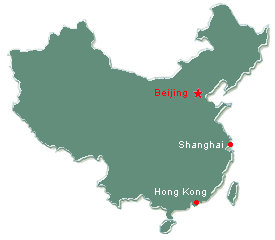
Beijing
Location
|
|
|
Beijing Basics |
 Area
(City) Area
(City) |
1,368
square km |
|
Area
(Metro) |
16,800 square km |
|
Population: |
21.84
million (2022) |
|
Coordinates: |
39°26'-41°03'N 115°03'-117°30'E |
|
Local
Time: |
|
|
January Average Temperature: |
-4.7°C
(23.54°F) |
|
July Average Temperature: |
26.1°C (78.98°F) |
|
Average Frost Free Days: |
180-200
days/year |
|
Average Elevation: |
20-60
meters |
|
Annual
Rainfall: |
484 mm
(2007) |
|
Annual Sunshine: |
2,000-2,800 hours
|
|
Phone Area Code: |
10 |
|
Postal Code: |
100000 |
|
|
|
Beijing Geography and Climate
(sponsored by
Beijing Tour)
|
Beijing,
China's national capital, is situated at the north edge of
the North China Plain. Not far to its northwest is the vast
Inner Mongolian Plateau and a hundred kilometers to the east
is the Bohai Sea. Beijng is also flanked by the crawling
Taihang Mountains to its west and the alluvial plain by the
rivers of Yongding and Chaobai to its south.
|
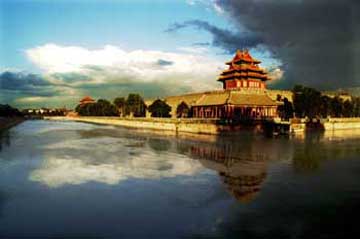
Corner Tower of the
Forbidden City of Beijing |
Located in the
North
Temperate Zone with a continental monsoon climate,
Beijing enjoys and annual mean temperature of 11.8°C
(53.24°F) and annual mean precipitation of 630 mm, which
concentrates mainly in the summer. January is the coldest
month with the monthly mean temperature of -4.7°C (23.54°F)
while July the hottest month with a mean temperature of
26.1°C (78.98°F). Beijing's spring is relatively short, and
people used to say that when the last day of the winter is
gone, the summer is about to set in. Summer is usually hot
with abundant rainfall. Autumn days are cool with clear sky
and gentle breeze, making it the best season to travel. As
winter is severe, outings naturally require heavy clothing.
Climatically, Beijing's
four seasons cater to different interests of
tourists. You can
travel at any time of the year as you like.
|
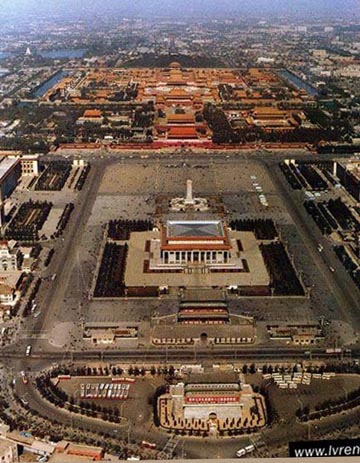
Bird's
view of Tianan'men Square, and the up part of the picture is the Forbidden City
(yellow-colored building roof) |
|
|
|
Brief History of Beijing |
Beijing is a
great city noted for the rich heritage of oriental
history and culture. As early as three thousand years ago, a
primitive tribal community started to take shape here. A
tone had already come into being two thousand years ago.
|
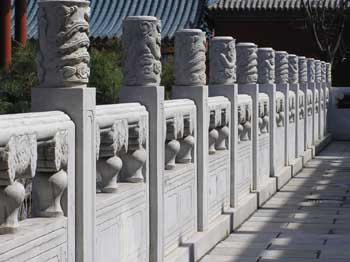
Beautiful Stone
Carving, Beijing |
From 900
A.D. onward, Beijing served first as the secondary capital
of the Liao Dynasty (916-1125) and then capitals of the Jin
(1115-1234), Yuan (1271-1368), Ming (1368-1644) and Qing
(1644-1919)Dynasties successively. Beijing was made the
capital of the People's Republic of China which was founded
on October 1, 1949.
|
|
|
Beijing Local Products |
Beijing and
its surrounding counties are known to have the best
quality Miyun dates, Jingbai pears and Liangxiang chestnuts.
King-size persimmon and especial the frozen ones are unique.
Preserved fruits from of a part of Beijing's traditional
speciality. The Beijing Duck is a fine breed, well-know for
its delicate meat. Beijing also offers artefacts, jade and
stone carvings, filigree and lacquer ware, jewellery and the
watercolor wood block printing of Rongbaozhai.
|
|
|
Beijing Local Cuisine |
Beijing
presents a galaxy of China's famous cuisine. Here you not
only are offered with four major schools of Chinese cuisine,
namely, Shandong, Sichuan, Jiangzhe and Guangdong, but have
a great variety of gastronomically specialities to choose
from Beijing, Hunan, Shanxi and Henan styles, let alone
numerous local flavors and snacks.
Beijing roast duck provides a special enjoyment to thousands
of
customers, Chinese and foreigners alike. The top restaurants
serving Beijing roast duck are Quanjude Roast Duck
Restaurant at Hepingmen and its branch at Qianmen and
Bianyifang Roast Duck Restaurants. They stick to the
traditional roasting method and maintain the original
flavor. You will find the duck with dark brown color, crispy
skin, and tender and tasty meat lightening the enjoyment of
the guests. Your visit to Beijing is incomplete without a
try at the Beijing roast duck.
You can also try the Beijing rinsed mutton with Mongolian
hot pot at Donglaishun Restaurant, imperial recipes at
Fangshan Restaurant, any of the famous dishes at Sichuan,
Guandong, Huaiyang, and Tanjin, styles at the Beijing Hotel
Restaurant, a "complete fish meal" at the Hall of Listening
to the Oriole Restaurant at the Summer Palace, or a
"complete pork meal" at Shaguoju or a "complete lamb meal"
at Hongbinlou. The Barbecue of Kaorou Ji and Kaorou Wan is
also quite famous.
There are many
attractions in Beijing which photographer can shoot good
pictures, such as Summer Palace, Great Wall, Tianmanmen
Square as below. They are all highlights in
Beijing tours when people travel to China. Except the
above 3 spots, Forbidden City is also a must seeing place
for travelers to learn Beijing and China history and for
photographers to take beutiful pictures.
|
|
|
Beijing Pictures |
|
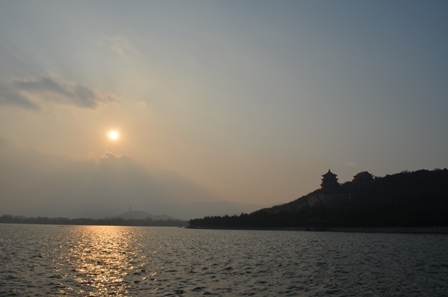
The largest royal park
in the world -- Summer Palace of Beijing |
|
|
|
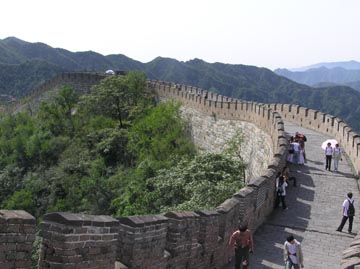
The Great Wall in
Mutianyu Section, Beijing |
| |
|
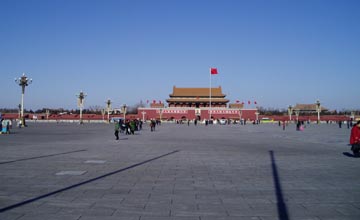
China's icon: Tiananmen Square,
the largest in the world |
| |
|
|
|
|
|
|
|
|
Useful
Links about Beijing |
|
|
|
|
Pictures:
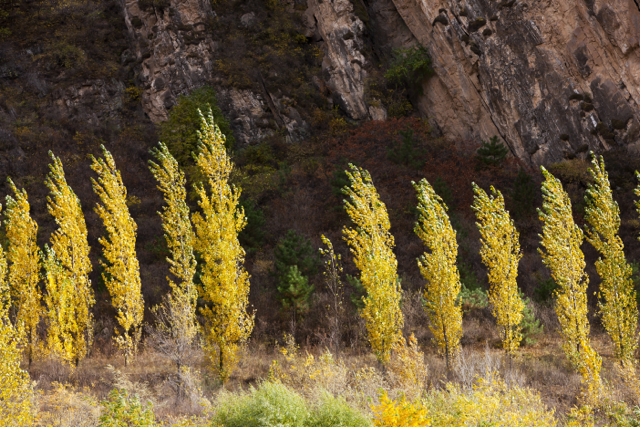
Fall in Suburb of Beijing |
|
 |
|
|
Pictures
about Old and New Beijing |
|
|
|
|
|
|
|
|
|
|
|
|
|
|
Statistics of Beijing
(Archive) |
-
Population: 13.819 million (3 million increase during the past
decade, increase rate: 27.7%, average annual increase rate: 2.4%)
-
Total
number of families: 4.176 million
-
Average
number of family members: 2.9
-
Men Vs.
Women: 52.1:47.9
-
The group
of 0-4 years old: 1.878 million, shares 13.6% of total city
population; The group of 15-64 years old: 10.786 million, shares 78%
of total city population; The group of 65 and older: 1.155 million,
shares 8.4% of total city population.
(2001 )
|
|
|
Beijing
Population (1948-2022) |
|
Year |
Population |
|
2022 |
21.84 million |
|
2010 |
19.61 million |
|
2009 |
17.55 million |
|
2008 |
16.95 million |
|
2007 |
16.33 million |
|
2006 |
15.81 million |
|
2005 |
15.38 million |
|
2000 |
13.64 million |
|
1998 |
12.46 million |
|
1988 |
10.61 million |
|
1978 |
8.72 million |
|
1958 |
6.60 million |
|
1948 |
2.03 million |
|
|
|
|
|
|
|