|
|
|
General Information about
Chongqing (Chungking) |
|
The
city of Chongqing (also called Shancheng, Qiaodu, Wudu) can be best described as southwest China’s
commercial capital. Since 1997, the city has become the fourth
municipality, independent from Sichuan Province, to be under the direct
control of the central government.
The
major port of the upper Yangzi River and gateway to the famous “Three
Gorges,”
Chongqing now includes most of the former eastern Sichuan
Province,
with a population about 30 million. It is a major center of iron and steel
production, motorcycle manufacturing and shipbuilding, as well as
chemical and pharmaceutical production. The religious cliff sculptures
of Dazu and Baodingshan and the Three Gorges scenic region of the Yangzi
River are all nearby, making Chongqing an important center for tourism
despite the scarcity of notable sights within the city proper.
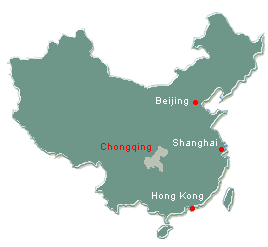
Chongqing lies at the
confluence of the Yangzi and Jialingjiang Rivers, centered on a hilly
peninsula encircled by the rivers, in what was formerly the eastern part
of Sichuan Province. Also known as the Mountain City, Chongqing is 1,025
km (640
miles)
northwest of Hong Kong, and 1,800 km (1,120
miles)
southwest of Beijing.
It
is one of the
four
“furnace cities” of China, with blazingly hot and humid
summers and cold, foggy winters.
Chongqing traces its
ancient history all the way back to the 13th
century
BC, when it was the capital of the Ba kingdom, with a distinctive local
culture contemporary with the Shang. It was given its present name,
which means “Double Celebration,” by the Southern Song Emperor
Guangzong in 1189, to commemorate his accessions to princely and then
imperial rank. At the end of the Song period, from 1242 to 1278, Song
forces held off Mongol invaders in the longest continuous military
campaign ever on Chinese soil, lasting some 36 years at nearby Hechuan,
60 km to the north of the city. Chongqing was opened as a treaty port to
British and Japanese traders in 1890.
Chongqing gained political
importance following the Japanese invasions of the late 1930’s. After
Nanjing fell in 1937, Chongqing became the wartime capital of the
Kuomintang regime from 1938 on, and a focus for refugees and bombing
raids that destroyed most of the city’s historical fabric. After the
Japanese surrender in 1945 and the breakdown of U.S. sponsored
negotiations held in Chongqing between the Kuomintang leader Chiang Kai-shek
and the Communist leader Mao Zedong, Chongqing remained a Kuomintang
stronghold until it fell to
the
People’s Liberation Army in 1949. Since then Chongqing has
grown dramatically in population and economic importance, becoming the
major industrial center of southwestern China.
|
|
|
General Information about the Three Gorges |
|
The Three Gorges
(San Xia)
scenic area on the
Yangzi River includes some 200 km of rapids and dramatic, sharp bends
set close between high limestone cliffs on either side, in the area
between Baidicheng in Sichuan and Yichang in Hubei Province. The
scheduled completion of the Three Gorges Dam project upstream from
Yichang around 2008 will raise the water levels some 100 m, forever
changing some of the most historically celebrated scenery in China. The
area is reached via ferries or cruise ships running downstream from
Chongqing to Yichang, or on to Wuhan or all the way to Shanghai.
In earlier times all
the way down to the early 20th century navigating this stretch of the
Yangzi River was dangerous and back-breaking work. Upstream vessels
often needed the labor of hundreds of trackers on the riverbanks who
hauled boats against the current using long ropes, sometimes taking
weeks. By the 1950’s the most troublesome rocks and reefs had been
removed, making the river navigable to ferry boats and cruise ships.
The first stop on the
route downstream from Chongqing is the town of Fuling, overlooking the
mouth of the Wu River that runs south into Guizhou. In the middle of the
Yangzi River here is a huge rock known as Baihe Ridge, with three
carvings known as “stone fish” on one side that may have served as
watermarks for navigation since ancient times. The next major town is
Fengdu, 193 km (120 miles)
northeast of Chongqing, and known as the “city of devils.”
The
first of the three Yangzi Gorges
is known as the Qutang Gorge,
which, at 8 kilometers long, is the smallest and shortest of the
Three Gorges, but contains the fastest water. On the north bank are
remains of Warring States Period peoples who buried their dead in
coffins set in crevices in high caves along the riverside cliffs. Nine
coffins discovered in such crevices include bronze swords and armor from
the period. The cliff sides include square holes bored into the rock to
hold support timbers for plank roads and scaffolds.
Wu Gorge (Wu
Xia) is about 40 km long, with sheer, narrow cliffs on either side
rising up to 900 m above the water and sometimes seeming to close over
approaching boats. A nearby rock inscription is attributed to Zhuge
Liang of the Three Kingdoms period, and the Kong Ming tablet, a large
inscribed rock slab at the foot of the Peak of the Immortals. A side
trip leads to the Three Little Gorges (Xiao
Sanxia) along the Daning River for 33 km, passing the Dragon Gate
Gorge and remains of a Qing dynasty road cut into the cliffs.
Xiling Gorge is the
longest and deepest of the three at 80 km, with cliffs that rise as high
as 4,000 feet. It begins at the town of Zigui, known as the birthplace
of the poet Qu Yuan of the late Warring States period (3rd
century BC), whose suicide is commemorated by dragon-boat races
throughout southern China. In former times this was the most
dangerous gorge, negotiated only with arduous efforts by trackers on
shore. At the end of the
gorge is the site of the Three Gorges Dam at Sanduoping, known as the
Gezhouba (Gezhou Dam), or
sometimes as the Da Ba (Big Dam).
When finished the dam will be 607 ft high and 2 km (1 1/2 mi) long. It
is designed to furnish one-third of the entire country’s electrical
power, to alleviate flooding problems, improve river navigation, and aid
the economic development of rural areas along the river.
|
|
|
|
|
|
|
|
|
|
Useful Links
about Chongqing |
|
|
|
|
|
|
|
|
|
|
|
|
|
|






 Chinese Cities and Province Information