|
|
|
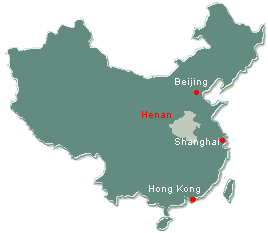
Geography of Henan Province |
Henan Province is located on the southern lower reaches of
the Huanghe River (Yellow River). It served as the capital
of 200 empires during its history of more than 20 dynasties,
leaving behind over 1.3 million relics. Henan Province has
seven state-level historical and cultural cities, and
Luoyang,
Kaifeng, and
Anyang are among China's Seven Ancient
Capitals.
Henan Province lies in the middle and lower reaches of the
Yellow River. It covers an area of over 167,000 square
kilometres and has a population of near 100 million,
consisting of the nationalities of
Han,
Hui,
Mongolian and
Manchu.
Zhengzhou is the capital city of Henan
Province.
|
|
|
Climate of Henan Province |
This province has
a temperate climate with distinctive four seasons. The
climate changes are fairly accurately represented by the
twenty-four solar terms on the Chinese lunar calendar. The
annual temperature averages between 12ºC
and 16ºC
(53.6 ºF and 60.8 ºF)
, with the minimum temperature
being -3ºC
to 3ºC
(26.6 ºF to 37.4 ºF) in January and the maximum temperature
being 24ºC
to 29ºC
(75.2 ºF and 84.2ºF) in July. Generally, the southern and
eastern parts of the province have warmer climate than the
western and northern parts of the province. Average annual
rainfall is between 500mm and 900mm, while heavy rains,
often torrential downpours, occur in July, August and
September.
|
|
|
Brief History of Henan Province |
|
Henan is one of the cradles of Chinese nation. There is a
site of the remains of the Yangshao Culture, which dates
back to the late period of the Neolithic Age, in the
Yangshao village, Mianchu County. A historical site of some
piles-up remains of the Xiaotun Culture, the Longshan
Culture and the Yangshao Culture has also been unearthed in
Anyang County. In Dahe village Zhengzhou, people have found
the remains mainly of the 5,000 year old Yangshao and
Longshan Cultures in another site of the Neolithic Age.
Henan was the political, cultural and economic centre of
China in ancient times.
Anyang,
Luoyang
and
Kaifeng
were capitals of different imperial dynasties. Agricultural
production began in Henan more than four thousand years ago.
The Yin Dynasty ruins in Anyang, the historical site of the
Shang Dynasty city in Zhengzhou, the Longmen Grottos in
Luoyang, one thousand year old Iron Pagoda in Kaifeng, the
Shaolin Temple and the Zhongyue Temple at the Songshan
Mountain, and the Song Dynasty tomb in Gongxian County from
an important part of China's splendid culture.
|
|
|
Henan Local Products |
The province
produces a wide variety of famous fruit, including
watermelon from Kaifeng, apple and date from Lingbao, pear
from Mengjin, grey date from Xinzheng, dried persimmon cake
from Yingyang, grape from Yifeng, walnut from the Funiu and
Taihang Mountains, and chestnut from Yongbai and Dabie
Mountains. Besides there are such important local products
as tussah silk produced from the Funiushan region, black
fungi from Lushi and Luanchuan, root of chrysanthemum,
chrysanthemum and Chinese yam cultivated in the northern
Henan area. Maojian tea from Xinyang, dried day lily from
Huaiyang and Yellow River carp are also very famous. It has
many renowned traditional handicraft products, such as Jun
porcelain from Yuxian County, Ru porcelain from Linru, jade
carving from Nanyang, tri-coloured glazed potty of the Tang
Dynasty produced in Luoyang, grass basketry from Zhengzhou,
embroidery from Kaifeng, tin-coated bottle from Hua Xian
County and ink stone from Jiyuan.
|
|
|
|
|
Places of Interests and Tourist Attractions: Henan |
|
|
|
|
|
|
|
|
|
Henan
Useful Links and Sites |
|
|
|
|
Henan
Related Article and Report Links |
|
|
|
|
Major
Cities in Henan Province |
|
|
|
|
Places of Interests and Tourist Attractions: Henan |
|
|
|
|
|
|
|
|






 Chinese Cities and Province Information