|
|
|
Geography of Shanxi |
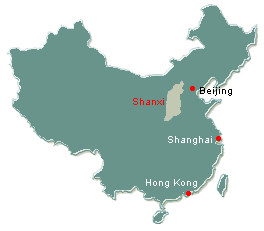
Situated
west of Mt. Taihang, in the eastern part of the loess plateau
and the middle reaches of the Huanghe River (Yellow River) , Shanxi
Province covers an area of over 150,000 square kilometres and has a
population of 36.00 million (2023) composed of
Han,
Hui,
Mongolian,
Manchu and other nationalities.
Taiyuan is the provincial capital.
|
|
|
Climate of Shanxi |
Shanxin Province is a highland with mountains in the east and south.
Shanxi's
temperature is lower than that of the same latitude in the North China
Plain. It has severe winter and cool summer. The average temperature of
the coldest month January is -12°C
(10.4 °F)
to -2°C
(28.4 °F)
from the north to the south and the average temperature of the hottest
month July is 22°C
(71.6 °F)
to 27°C
(80.6 °F)
from the north to the south. The annual precipitation is between 350mm
and
700 mm, most of which falls in summer.
|
|
|
Brief History of Shanxi |
Shanxi was Jinyang in ancient times. During the Spring and Autumn
Period it was the Kingdom of Jin (770 B.C.-476 B.C.), the Qin Dynasty
(221 B.C.-207 B.C.), Taiyuan Prefecture, in the Tang Dynasty (618-907),
Hedong Dao (Dao was equivalent to today's province). It was in the Qing
Dynasty (1644-1911) that the place became to be known as Shanxin
Province. Shanxin is one of the cradles of Chinese civilization. As the
legend goes, kings Yao, Shun and Yu had their capitals in southern
Shanxi. Ruins of the middle period excavated in Dingcun Village in
southern Shanxin show that what has come to be know as "Dingcun Man"
lived there hundreds of thousands of years ago. Now Shanxi has become
one of the major heavy industrial bases and the biggest coal mining area
in China.
|
|
|
Shanxi Local Products |
Shanxi Province produces a great variety of fruits. The main ones
are pears and dates. The best pears are produced in Yuangping. Dates
from Jihan have small cores, thick pulp and rich sugar content.
Qingxu has a long history in grape-growing and is noted for the
variety of grape it produces. Other fruits include smooth-shelled
walnuts of Fenyang, persimmons of Jishan and wild jujubes of
Jiaocheng. Chinese medicinal herbs grown in this province include
Dangshen ,the roots of membranous milk vetch ( Astragalus
membranaceus) and licorice roots. Shanxi Province produces the
famous Guilingji and Dingkun pellet, patent Chinese medicine. The
aged vinegar of Qingxu County is one of the famous vinegars in China.
|
|
|
Shanxi Local Cuisine |
|
Qingheyuan Restaurant of Taiyuan is known for its Tounao which is
instant cooked mutton in Mongolian hot pot and the whole sheep meal.
Tounao is fat mutton, lotus roots and yam cooked with rice wine, the
roots of membranous milk vetch (Astragalus membranceus). It is a
popular food with a tonic effect. Shanxi is also praised for its
rich
variety of wheaten food which is made even more delicious when
eatenwith famous vinegar of Shanxi.
There are altogether
about 100 varieties of wheaten food prepared in six different ways:
boiled, steamed, stuffed, fried, baked and deep-fired. The common ones
are hand drawn noodles, fettuccine Shanxi style, "cat's ears" etc.
Marinated beef from Pingyao is tender, soft, delicious and easy to keep.
|
|
|
Places of Interest and Tourist Attractions: Shanxi |
|
In Shanxin Province one can get a glimpse of Chinese gardening,
architecture, sculpture, carving and other arts. The statues of the
maids of the Song Dynasty (960-1280) in Jinci Temple of Taiyaun are
considered masterpieces of ancient Chinese sculptures. These statues
together with the ageless cypresses of the Zhou Dynasty (1112 B.C - 221
B.C.) and gurgling Nanlao Spring (Spring-for-ever-young), are regarded
as the three most enchanting scenes of Jinci Temple.
In
Taiyuan there are other tourist attractions such as Twin Pagodas
Monastery, Chongshan (Worshipping Goodness) Monastery, grottoes of Mt.
Tianlong (Celestial Dragon), Xuankong Monastery, Shuanglin Monastery and
the provincial museum.
Yungang Grottoes of Datong are one of the three treasure troves
of art in China. Fifty-three grottoes remain in which there are 51,000
statues. The biggest is 17 meters high and the smallest, a few
centimeters. The stone images of these grottoes are impressive, lively
and fascinating. Yungang Grottoes have even won world-wide fame. Other
scenic spots and places of historical interest in Datong include Huayan
Temple, Shanhua Monastery, the Nine-dragon Screen, Xuankong Monastery
and the wooden tower of Yingxian County.
Pingyao, an ancient city
of Shanxi province, was the financial center of China from the 17th to
19th century. Although today it is only a tiny spot on the map, almost
beyond recognition, Pingyao boasts a brilliant past with rich culture
deposits. Even now, the shops, booths and other buildings bearing the
authentic styles of the Ming (1368-1644) and Qing (1644-1911) dynasties
are still well-preserved. (Click
for more about Pingyao)
|
|
|
Shanxi
Related Article and Report Links |
|
|
|
| |
|
|
|
|
Shanxi Useful Links and Sites
|
|
|
|
|
Major Citis
in Shanxi Province: |
|
|
|
|
Tourist
Attractions
in Shanxi Province: |
|
|
|
|
|
|
|
|




 Chinese Cities and Province Information