|
|
|
Geography of Tianjin |
|
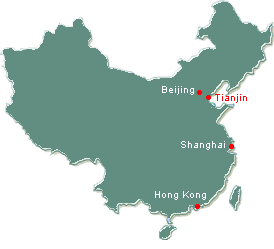
Tianjin, 137 kilometers southeast of Beijing, is located at 39º8' North
and 117º2' East, covering area of 11,917 square kilometers, the city is
bordering on the Bohai Sea in the east. It is one of three
municipalities of China directly under the Central Government. The five
main tributaries of the Haihe River, namely, the Yongding, Daqing, Ziya,
Nanyunhe and Chaobai, coverage here to from the Haihe River, which flows
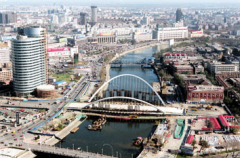
through the city and empties into Bohai Sea at Dagukou. The terrain in
Tianjin is low and flat, with an altitude of only two to five metres
above sea level. Most part of the city is on the Haihe Plain.
|
|
|
Climate of Tianjin |
|
The climate of Tianjin is temperate, continental-type monsoon climate
with four seasons distinct from one another. The mean temperature of the
year is 12.2ºC (
53.96ºF) with that of January being -4ºC (24.8 ºF)
and that of July 26.8ºC
( 80.24ºF) . The average
annual rainfall is 559.1mm, most of which is concentrated in summer. The
freezing period of ports lasts 80 days. |
|
|
Brief History of Tianjin |
|
Tianjin gradually took shape in 12th century when more and more
settlements were established. It was a county town in the Qing Dynasty
(1644-1911) and became a municipality in 1928. After the attack by the
Anglo- French aggressor troops 1860.Tianjin was then turned into a
trading port. Tianjin became one of centres of industry foreign trade
and science-technology of socialist China now. |
|
|
Tianjin Local Products |
|
Tianjin is renowned for Xiaozhan rice and teems with yellow croakers,
Chinese herrings, Spanish mackerels, chub mackerels and prawn. Tianjin
exports large quantities of Chinese cabbages, small and beans and green
turnips. Handicraft articles such as carpets, kites and painted clay
figurines as well as Yangliuqing New Year pictures enjoy high reputation
abroad. Besides, tablecloth, embroidered blouses, woven straw articles,
play diabolo, Western-style silver cutlery, headdresses, jewellery, jade
and ivory carving are also very famous. |
|
|
Tianjin Local Cuisine |
The local
food In Tianjin characterized by a variety of sea food
combines special features of Sichuan, Shandong, Huaiyang and
Zhejiang food to form a unique style of its own. Food of the
French, English, Italian and Russian style are also served
in hotels and restaurants here. Besides, there are many
kinds of snacks. Tourists can enjoy delicious food of either
the Chinese or Western style in Tianjin.
|
|
|
Places of Interests and Tourist Attractions of Tianjin |
The
Shuishang Park (Water Park), the largest park in Tianjin,
covers an area of 200 hectares. Half of the park is water
surface, which is divided into the east lakes, the west lake
and several smaller lakes. Inlaid on the lakes are 13
islets, which are decorated with pavilions, towers and
terraces and connected with one another by exquisite curved
bridges, arch bridges and dykes lined with weeping willows,
giving a unique charm to the park.
|
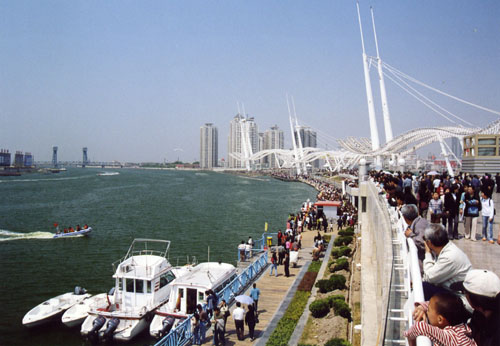
Shuishang Park, Tianjin |
Adjacent to the park is the Tianjin Zoo, which is renowned
for its novel architecture and collection of rare animals
such as the giant panda.
The Panshan scenic spot in Jixian County is a tourist
attraction, famous for its scenery and historical relics.
Dule (Exclusive Happiness) Temple has a history of over
1,000 years behind it. The Guanyin Tower in the temple is
among the most ancient wooden architecture existing in China
today. The clay sculpture of the goddess Guanyin with her 10
smaller heads is also the biggest of it kind in the country.
Located in
the city, the Memorial Hall of Zhou Enlai is the place where
the late Premier used to study and takes part in
revolutionary activities.
Tianjin is an industrial centre. Its petrochemical industry
has developed considerably since the extraction of land and
offshore oil. The Dagang oilfield and the chemical fibre
plant are open to tourists and visitors.
Tianjin is also a cultural city and has museums of natural
history, history and arts which attracted visitors with
their rich collections. Schools, universities and other
medical and scientific institutions have close ties with
foreign countries. The well-known Tianjin University, Nankai
University, Tianjin Medical College and Tianjin Hospital
often hold seminars and receive specialized visitors.
Many products made in Tianjin are popular at home and
abroad, such as the "Fengchuan" brand quality hand-made
carpets, Yangliuqing Hand-Made New Year Pictures, Painted
Clay Figurines of the Zhang Family, the "Dunhuang" brand
kites, etc. A visit to the workshops of these products is
appealing to many tourists."
In Tianjin, tourists can also enjoy a great variety of
performing arts, such as Beijing (Peking) Opera, Ping Opera,
Hebei Bangzi (A kind of local opera), plays, Shaoxin Opera,
acrobatics, puppet shows, etc.
Tianjin has been famed as "Home of Footballs", and
baseball's also very popular in Tianjin. National and
international tournaments are often organized here.
With a long history, the folk art galas in Tianjin are most
colourful. During holiday of the Spring Festival and Lantern
Festival, hundreds of thousands of people take part in the
performance of dragon dance, lion dance, walking on stilts
as well as Wushu (Martial arts). Such galas attract
thousands of tourists.
|
|
|
More about
Tianjin
|
|
Tianjin
is best known for its
streetscapes of colonial era buildings, a residue of its status as a
Treaty Port after 1858. Now a center of multinational businesses
concentrated in the new satellite city known as TEDA
(Tianjin Economic Development Area), Tianjin has an extensive modern
infrastructure, and is known for the high quality of its industrial
products.
Early settlement in the
Tianjin region dates
back to the Warring States period, but Tianjin’s later prominence was
primarily tied to the rise of nearby Beijing as the capital of northern
nomadic dynasties and later of the country as a whole. Tianjin served
primarily as a storage, sale, and distribution center for
agricultural products from the south in the 12th century. Under the
Mongols, who first established Beijing as the capital of the entire
country, Tianjin served as a storage and trans-shipment point for the
grain taxes that were shipped from the south
Tianjin’s prosperity
proved a lure for Western trading nations. In 1856 British and French
troops used the boarding of a British ship by Chinese troops in search
of pirates as an excuse to attack the forts guarding the Haihe
River. The defeated Chinese were forced to sign the 1858 Treaty of
Tianjin, which opened the port to foreign trade and the sale of opium.
Other European nations and Japan followed, establishing distinctive
independent concessions on the riverside areas, each with a distinctive
architectural style -- variously English Victorian, Italian Roman style
streets, French chateaux styles, and German Bavarian villas.
Tianjin became a center
of urban modernization and internationalism in the early years of the
20th century. Hotels like the Astor received famous guests such as
Herbert Hoover and Sun Yat-sen, and one of China’s first elevators was
installed there in 1924. Meanwhile, heavy silting of the Haihe
River led to construction of a new port at Tanggu, 50 km downriver, as
Tianjin lost its character as a major port city. The 1976 Tangshan
earthquake caused extensive damage to
the city, and it was closed to foreign visitors until repairs
were completed. The establishment of the Tianjin Economic and
Development Area was a major spur to investment and economic
revitalization.
|
|
|
|
|
|
Useful Links
about Tianjin |
|
|
|
|
Tianjin Related Article / Report Links |
|
|
|
|
|
|
|
|
|
|
|
|
|
|
|
|





 Chinese Cities and Province Information