|
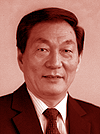
Zhu Rongji was born in
Changsha, capital of central China's
Hunan Province. He
joined the Communist Party of China in October, 1949. After graduation from the
prestigious Qinghua University, where he majored in electrical engineering, he
worked for the Northeast China Ministry of Industries as deputy head of its
production planning office.
During 1952-58, he worked in the State Planning Commission as group head,
deputy director of minister's office, and deputy section chief.
From 1958 to 1969, Zhu continued to work in the State Planning Commission, as
a teacher at a cadre school and an engineer. From 1970 to 1975, he was
transferred to work at a "May Seventh Cadre School", a kind of farm for
re-education during the Cultural Revolution.
From 1975 to 1979, he served as deputy chief engineer of a company run by the
Pipeline Bureau of the Ministry of Petroleum Industry and director of Industrial
Economics Institute under the Chinese Academy of Social Sciences. From 1979 to
1982, he worked for the State Economic Commission as division chief and bureau
deputy director. He was appointed member of the State Economic Commission in
1982 and vice-minister in charge of the commission in 1983, where he held the
post until 1987 before he was appointed mayor of Shanghai.
The three years of his office as Shanghai mayor saw tremendous changes in the
development and opening-up of Pudong, a Singapore-size area wedged between
Shanghai proper and the East China Sea, as well as in the city's telecoms, urban
construction and transport sectors. For these he won popular respect and
acclaim.
In 1991, Zhu became vice-premier of the State Council and director of the
State Council Production Office. He has focused his attention on tackling tough
economic problems in industry, agriculture and finance.
Soon after he came to Beijing from Shanghai, Zhu launched a drive to
disentangle the "debt chains" of state enterprises; he took the lead in
eliminating IOUs in state grain purchasing for the sake of farmers. He served
concurrently as governor of the central bank to straighten out the financial
order. Deng Xiaoping once said that Zhu "has his own views, dares to make
decisions and knows economics."
The year of 1992 saw runaway investment in fixed assets, an excessive money
supply, soaring prices and a chaotic financial market. With support from Jiang
Zemin and Li Peng, Zhu, as vice-premier and head of the State Council Economic
and Trade Office, took tough macro-economic control measures. He began by
bringing runaway money supply under control, laying a foundation for driving
down prices. Zhu did did not advocate overall entrenchment, however.
While he axed low-tech duplicated projects and sectors that would result in
"a bubble economy", Zhu backed projects in transport, energy, agriculture and
sectors that had promising prospects as new areas of economic growth. Thanks to
these measures, the Chinese economy has been able not only to avert violent
fluctuations but also maintain a healthy development.
Now Zhu Rongji has turned to reforming state enterprises. His attention is
also focused on strengthening agriculture as the economic base of the country
and on continuing a moderately tight monetary policy. He faces both
opportunities and challenges, observers note. And he has much room to display
his talent.
"Strict administration" is a principle he upholds. He deports himself in a
calm and unhurried manner, but he is decisive in handling affairs and quick to
act. He cannot tolerate a dilatory style of work.
"My criticism is too severe sometimes and that is not good," he once said.
"But why don't you start doing your work unless your leader flies into a rage?
It is not that you cannot do it but that you don't want to do it." But he
declared that he only criticizes people but never fixes anybody.
Zhu also shows his emotional side sometimes. At the 80th anniversary of the
founding of Qinghua University, his Alma Mater, Zhu defied fatigue from a long
European visit and rushed to the school to offer his greetings.
Between 1993 and 2003, Zhu served as a member of the Standing Committee of
the Political Bureau of the CPC Central Committee, vice-premier of the State
Council and concurrently governor of the People's Bank of China. Since 1995, he
has kept the positions of Standing Committee member and vice-premier. In
September, 1997, Zhu Rongji was re-elected member of the Standing Committee of
the Political Bureau of CPC Central Committee, Premier of the State Council, as
the fifth premier of the People's Republic of China.
Zhu has a good command of English. He is rarely seen speaking from script.
His eloquent speech has always riveted the attention of his listeners. Zhu is
also a Peking Opera fan.
His wife, Lao An, was once vice-chairman of the board of directors of China
International Engineering and Consulting Corporation. She and Zhu were in the
same schools twice, first the Hunan First Provincial Middle School and then
Qinghua University. They have a son and a daughter.
(source: China official news agency,
Xinhua News)
Zhu Rongji, the China's 5th premier
since the funding of the P.R.China in 1949, he was China's premier between 1998
and 2003. |